

The USDA will release its November WASDE and Crop Production reports on Tuesday. The reports draw focus back to the yield debate following the USDA’s September yield correction published last month.
As reported previously, the October numbers were “reviewed, validated and not changed,” NASS said. The November report will incorporate additional harvest information and revised demand projections.
Corn exports could overshadow yields
Ahead of the report, a Bloomberg survey of analyst estimates projects the national corn yield at an average of 180.6 bushels per acre (bpa), down 0.6 bushels from October’s number.
Slightly lower yields are expected to lower the corn production projection to 15.98 billion bushels, down 54 million from October. Larger adjustments may come from the demand side of the balance sheet.
U.S. corn export commitments are running about 34 percent behind last year’s pace and are below the five-year average of 24.8 million metric tons (MMT). Commitments have reached 30 percent of the USDA’s target, compared to the five-year average of 41 percent.
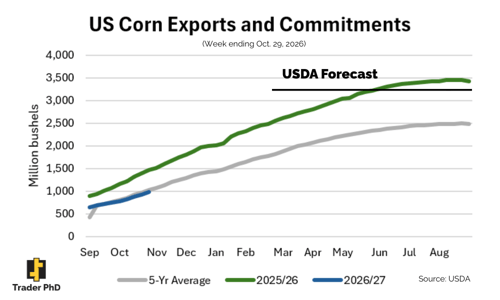
Meanwhile, the USDA is currently projecting exports to decline by only about 4 percent from the previous marketing year. The slower pace of commitments suggests a possible downward revision in the forecast.
Corn ethanol demand remains resilient, as production has continued to run at a record pace since the beginning of the 2026/27 marketing year. Strong ethanol production and corn crush since the beginning of the marketing year suggest that processors have not had difficulty getting their hands on corn.
Currently, the Bloomberg survey pins U.S. corn ending stocks for 2026/27 just 3 million bushels lower than October at 1.846 billion.
World corn ending stocks are expected to increase by 0.8 MMT to 281.2 million.
Soybeans export positive to balance sheet
Soybean yields are expected to increase from last month’s projection. The average analyst guess pinned the yield 0.4 bushels higher at 53.5 bpa. Higher yields pinned production 34 million bushels higher at a record 4.6 billion bushels.
Total U.S. soybean export commitments reached 30.23 MMT as of Oct. 29, sitting 76 percent ahead of last year. Additionally, commitments have reached about 66 percent of the USDA’s target, well ahead of the five-year average.
It’s likely the USDA could raise its export forecast based on the strong pace of sales to China and other countries. So far, China’s commitments of U.S. soybeans reached 16.22 MMT, about 65 percent of the 25 MMT commitment.
If China reaches the 25 MMT, exports to the country will only be at the five-year average from stronger shipments in previous years. However, the strong pace of domestic soybean processing suggests that China doesn’t need to go beyond the current pledge for total U.S. soybean demand to be a record this season. That does assume that exports and crush reach the USDA’s current forecasts.
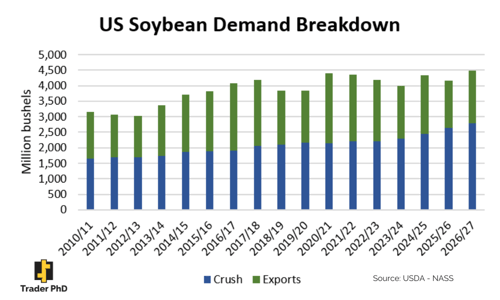
The USDA reported on Monday that U.S. soybean crushings reached 200 million bushels in September, down 3 percent year-over-year. It’s too early in the marketing year for the USDA to adjust the crush pace.
If production remains relatively unchanged, an increase in projected demand, particularly in exports, could result in lower ending stocks. The Bloomberg survey pins U.S. soybean ending stocks for the current season 17 million bushels higher at 332 million.
Wheat outlook
The focus for wheat in this month’s WASDE will be demand, as production estimates have largely been established.
Despite a recent improvement in wheat export sales last month, overall commitments for the 2026/27 marketing year are running about 28 percent below last year at 12.18 MMT. That was also 60 percent of the USDA’s target, compared to the five-year average of 67 percent.
Limited supplies and strong U.S. prices compared to global competitors have limited wheat export demand after shipments hit a five-year high the previous season. That being said, lower demand expectations could lead to an increase in the domestic ending stocks forecast. Bloomberg’s survey pins the forecast 4 million bushels higher from October at 744 million.
Global ending stocks are pinned at 276.6 MMT, up 0.6 million from a month ago.
--
PAST PERFORMANCE IS NOT INDICATIVE OF FUTURE RESULTS. FUTURES TRADING INVOLVES SUBSTANTIAL RISK AND IS NOT SUITABLE FOR ALL INVESTORS.