.png?width=2347&height=620&name=outlined%20ag%20marketing%20logo%20black%20(1).png)

Surging diesel prices are having an impact on producer costs at the front end and back end of production margins.
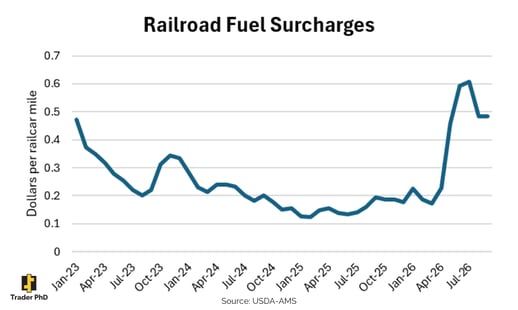
According to the latest USDA grain transportation data, the North American weighted average railroad fuel surcharge rose to $0.48 per railcar-mile in the second week of September. This is an increase of nearly 153 percent compared to the weighted average seen a year earlier and 140 percent above the prior three-year average.
Rising grain-shipment fuel surcharges are hitting farmers just as many begin the harvest season. Not to mention the higher costs associated with fueling up farm equipment for the time of the year when combines hit the fields and semis are trucking grain loads. According to the EIA on Tuesday, the average on-highway diesel price across the U.S. increased $0.24 from last week to nearly $6.53 per gallon this week.
Higher rail and fuel costs can reduce the value of grain at the origin, potentially putting pressure on local elevator bids and weakening basis. According to the latest grain transportation data, rail tariff and fuel surcharge costs for corn and soybean shipments have largely increased from a year ago, potentially adding to the cost of moving grain to market as harvest approaches.
For example, a corn rail shipment from Gibson City, Illinois, to Reserve, Louisiana, carried a reported tariff and fuel surcharge of $0.86 per bushel in Sept. While the rate was below the highest reported surcharges of more than $1.70 per bushel, it was still 16.7 percent higher than the same route a year ago and one of the largest percent increases reported in the latest data.
Railroad surcharges are up nearly 60 percent year-over-year, reported Reuters. According to the Surface Transportation Board, railroads collected $2.93 billion in fuel surcharges during the second quarter, a 90 percent increase from the same period a year ago.
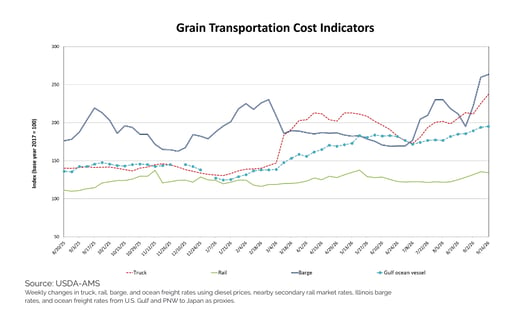
Surcharges go into effect when fuel costs reach or exceed a strike price ranging from $2.30 to $3.25 per gallon, based on the U.S. On-Highway Diesel Fuel Index. As the index rises, so does the surcharge.
Rising diesel prices don’t just affect the cost of filling a farm truck; they can ripple through the broader grain transportation system. As harvest approaches, higher transportation costs could become an increasingly important factor in local grain prices and basis.