.png?width=2347&height=620&name=outlined%20ag%20marketing%20logo%20black%20(1).png)

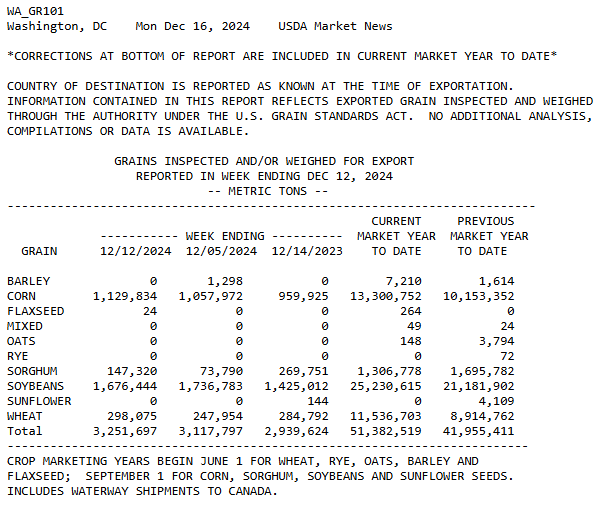

If you're trying to track U.S. grain exports, you’ve probably heard of two key USDA reports: the...
Understanding Basis in Grain Marketing
What is basis in grain marketing?
Basis is the difference between a local cash price and the futures price for a commodity. Basis affects cash prices because it reflects local supply and demand, along with transportation, storage, and handling costs.
In buying or selling physical grains, the local cash price can be very different from the price that is quoted in the futures market. These local market factors influence basis, which in turn causes local cash prices to trade above or below futures prices.
The basic definition of basis, or the calculation, is the cash price minus the futures price. Another way to look at it would include:
Cash Price = Futures + Basis
Basis can therefore be positive or negative. A negative basis is when the cash price is below the futures price. A positive basis would be the opposite: when the cash price is above the futures price.
When local grain supplies are plentiful and demand is weak, basis tends to weaken, and cash prices fall relative to futures prices. When local supplies are tight or demand is strong, basis tends to strengthen as buyers increase cash bids to attract grain.
How basis is used in grain marketing
Looking at an example of basis at work, let’s say a farmer is looking to sell corn and is comparing the cash price versus the futures price. The local grain elevator cash price is $4.20 per bushel. The December corn futures contract is $4.50 per bushel.
As a basis calculation, that would be $4.20 minus $4.50, which equals negative 30 cents or 30 cents under. That would mean this scenario would be a negative basis.
Now, let’s flip the script. Let’s say the local grain elevator is willing to pay a cash price of $4.60 per bushel while the December corn futures contract remains at $4.50 per bushel. That calculation would be $4.60 minus $4.50, which equals 10 cents. That is a positive basis.
Summary
Basis measures local market conditions. While futures prices reflect broader national or global market trends. That is why basis becomes important for hedging - basis impacts what a producer receives at the time of sale.
Understanding basis is important in grain marketing to identify what favorable selling opportunities exist and determine the final price received for grain.
Basis is not only a key marketing tool, but it is also worth understanding when making sound and informed decisions regarding your operation.
--
PAST PERFORMANCE IS NOT INDICATIVE OF FUTURE RESULTS. FUTURES TRADING INVOLVES SUBSTANTIAL RISK AND IS NOT SUITABLE FOR ALL INVESTORS.
Want to receive more commodity-related information? Sign up for a free trial to stay up-to-date on the latest market trends.