.png?width=2347&height=620&name=outlined%20ag%20marketing%20logo%20black%20(1).png)

The USDA released its February WASDE report on Tuesday, offering a few balance sheet adjustments for the U.S. and global supply and demand outlooks.
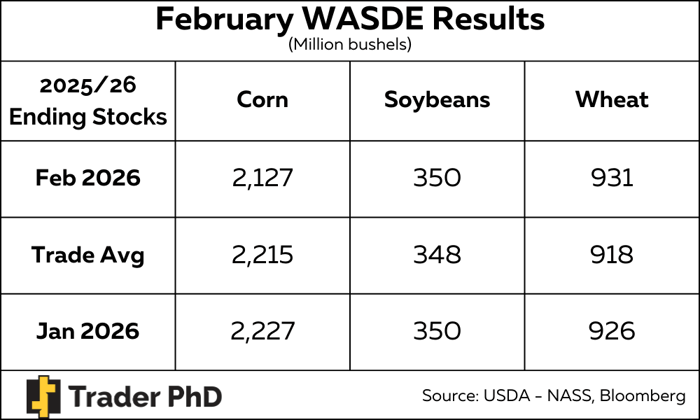
 Headlining the U.S. corn balance sheet was exports. The agency raised its 2025/26 export forecast to 3.3 billion bushels, up 100 million from the January report although, surprisingly, the USDA left the feed and residual usage category unchanged. The 2025/26 corn carryout was reduced to 2.127 billion bushels, down 100 million from January. World corn ending stocks were lowered to 289 million metric tons (MMT), down 1.9 MMT from January. Lower stocks in the United States drove the decline, but was partially offset by higher stocks for Ukraine and Iran.
 The USDA left the U.S. soybean balance sheet unchanged this month, with the 2025/26 ending stocks forecast at 350 million bushels. The report recognized China's potential to buy an additional 8 MMT of U.S. soybeans this season but left the export forecast unchanged on the expectation of lower exports to the rest of the world. Global ending stocks were raised to 125.5 MMT, up 1.1 MMT from the previous forecast, reflecting higher stocks in Brazil. The Brazilian 2025/26 production forecast was raised to 180 MMT, up 2 MMT from the previous month.

The U.S. wheat carryout for 2025/26 was raised to 931 million bushels, up 5 million from January due to lower domestic use. Additionally, ending stocks are forecast to be 9 percent higher than the previous season and the largest since the 2019/20 marketing year. Global ending stocks were reduced to 277.5 MMT, down 0.8 MMT. The global wheat ending stocks forecast decreased for the first time in six months, but the carryout is still forecast at a five-year high.
 The USDA raised its 2025/26 cotton ending stocks forecast to 4.4 million bales, up 200,000 bales from the January report, due to reduced export demand. The higher carryout translated to an increase in the stocks-to-use ratio to 32 percent, the highest since the 2019/20 marketing year. The USDA forecasts the average farm price of cotton at 60 cents a pound for the season, which has been the average since the start of the season, according to price received data. Rising supplies in Brazil have made the country more competitive on a global scale, diverting demand from the U.S.
 The USDA raised its 2026 milk production forecast to 234.5 billion pounds, up 300 million from the January forecast. The increase was due to faster growth in milk per cow more than offsetting a lower expected cow inventory. U.S. milk production reached a record 231.5 billion pounds in 2025, led by rapid growth in the milk cow herd and milk per cow. That growth is expected to continue to grow an average 2 percent annually through 2030.

All rice exports were cut by 2 million cwt to 87 million, which is forecast to fall by nearly 4 percent year-over-year and the lowest since the 2022/23 season. With imports lowered by 1 million cwt, total ending stocks were raised to 50.3 million cwt, up 1 million from January. The stocks-to-use ratio was raised to 19.5 percent. Global ending stocks were raised to 190.9 million metric tons (MMT), up 0.5 MMT from January. Stockpiles are expected to decline year-over-year but remain the second-largest on record.
--
PAST PERFORMANCE IS NOT INDICATIVE OF FUTURE RESULTS. FUTURES TRADING INVOLVES SUBSTANTIAL RISK AND IS NOT SUITABLE FOR ALL INVESTORS.