

Following an impressive run-up in hog prices during the first and second quarters of 2026, the market has undergone a multi-month correction. The decline in prices has been driven by adequate domestic supplies and limited demand compared to beef and chicken. Before digging into those factors, it’s important to examine how current production systems generate market swings that heavily impact producer returns.
U.S. pork production outperforms demand
The hog industry is used to large price swings, primarily due to the short time needed to turn an undersupplied market into an oversupplied one. Over the decades, productivity gains have allowed the U.S. swine industry to produce more pork and market-ready animals using fewer resources, lower costs, and reduced time.
That has been apparent in the USDA’s Quarterly Hogs and Pigs reports. For years, producers have been reducing the number of sows farrowing, while rising litter rates have kept the total pig crop stable.
As the number of pigs remained steady, relatively cheap feed costs earlier this year helped push domestic hog weights to multi-year highs. Steady slaughter rates and higher dressed hog weights have left pork production virtually unchanged compared to a year ago.
Because meat packers have not had to bid as aggressively this year to secure supplies, cash and cutout values didn’t get their typical seasonal bump during the primary grilling season. Even as hog slaughter fell below year-ago levels in August, September, and October, prices failed to catch a notable bid.
Despite record beef prices, consumers are projected to substitute away from high-priced beef and towards chicken for price reasons. Consumers who would prefer not to buy beef are likely to buy chicken given its price advantage indicated by these average prices from the U.S. Department of Labor, Bureau of Labor Statistics.
When consumer demand slows, pork prices decline, and wholesalers pay hog processors lower prices for pork cuts. Eventually, processors pay hog producers lower prices for hogs, and producers slow hog production by slowing expansion of the breeding inventory.
Exports become a primary demand driver
Exports account for roughly one-quarter of U.S. pork production, making international demand a critical driver of domestic prices. That relationship is likely to remain important in the years ahead.
According to monthly data from the U.S. Census Bureau, pork exports totaled 222,000 metric tons (MT) in August, down from 236,000 MT in August 2025. Still, year-to-date exports are running about 1 percent higher than a year ago at 1.95 million metric tons (MMT) due to strong shipments during the first half of the year.
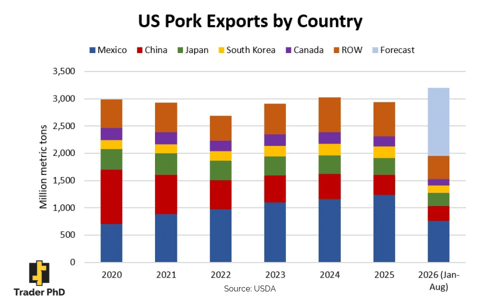
Exports for the first eight months of the year are running 3 percent lower to Mexico, while shipments to South Korea are down 8 percent. The declines are being offset by higher shipments to China (9 percent), Japan (13 percent), and Central America (11 percent).
Continued weakness in Mexico’s demand for U.S. pork along with an abundance of exportable pork supplies in major exporting countries prompted modest reductions in quarterly U.S. pork export forecasts, according to the USDA in an October report.
Like other commodities, Brazil remains a headwind for U.S. pork exports. The country exported a record 1.8 MMT of pork in 2025, marking a 12.5 percent increase from the previous year, according to the country’s trade ministry.
Like the U.S., China was a primary buyer of Brazilian pork in the early 2020s due to African Swine Fever devastating the Chinese hog herd in 2018 and 2019. China represents a much smaller percentage of total Brazilian pork exports. However, total shipments have not slowed due to growth in other parts of Asia and the Western Hemisphere.
Watching Brazil’s trade flows will be key for future U.S. export demand. In September, the USDA already recognized that lower demand and increased global competition could challenge U.S. shipments.
Price effect on producer margins
Estimated producer margins tightened significantly in September due to smaller hog returns. Estimated hog returns for a farrow-to-finish operation in Iowa shrank to just $1.71 per head last month, according to Iowa State University.
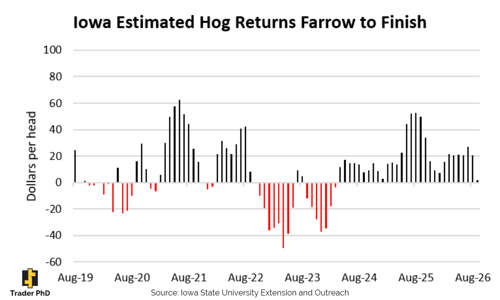
That is a far cry from the record losses posted in 2023. Margins have held in positive territory for more than a year despite normalizing from the highs seen in 2025.
As we move through the fourth quarter of 2026 and into 2027, the hog market could face continued pressure and limit producer returns. That will be driven by adequate supplies in the U.S. and globally, as well as strong global export competition.
Consumers and importers should eventually find that pork is becoming a bargain. The old adage of “high prices cure high prices, and low prices cure low prices” has yet to bring stability in wholesale pork values.
In the meantime, producers should focus on risk management tools to limit downside exposure. Taking another look at costs will also help producers manage a tighter margin environment.
--
PAST PERFORMANCE IS NOT INDICATIVE OF FUTURE RESULTS. FUTURES TRADING INVOLVES SUBSTANTIAL RISK AND IS NOT SUITABLE FOR ALL INVESTORS.